



Luciferases & GFPs Products
| Cat# | Name | |||||||||||||
|---|---|---|---|---|---|---|---|---|---|---|---|---|---|---|

| 321 | One of the smallest and brightest cloned luciferases. | 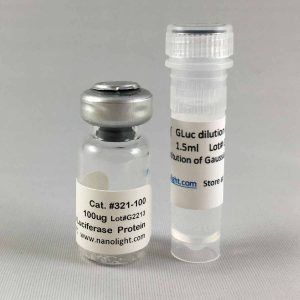
One of the smallest and brightest cloned luciferases. Gaussia Luciferase Protein Details
| |||||||||||

| 371 | Gaussia(M2)-Luciferase-Streptavidin is a conjugate of one of ... | 
Gaussia(M2)-Luciferase-Streptavidin is a conjugate of one of the brightest luciferases and a protein with the highest known affinity in nature. This fusion protein can be used to detect trace amounts of biotinylated protein, DNA, or other biotinylated bio-molecules. Gaussia Luciferase-Streptavidin Details
In experiments we were able to visualize the GLuc luminescence on the surface of Agarose-Biotin beads using a standard light microscope in total darkness. GLuc-SA was engineered by connecting one molecule of GLuc to one Streptavidin subunit. Streptavidin consists of 4 subunits with theoretically 4 biotin binding sites. Purified Streptavidin will have the ability to bind between 3.2 and 3.9 biotin molecules. Due to extensive purification steps, no free Streptavidin is present and cross-linking will be prevented, enabling quantitative read-outs in luminescent assays. 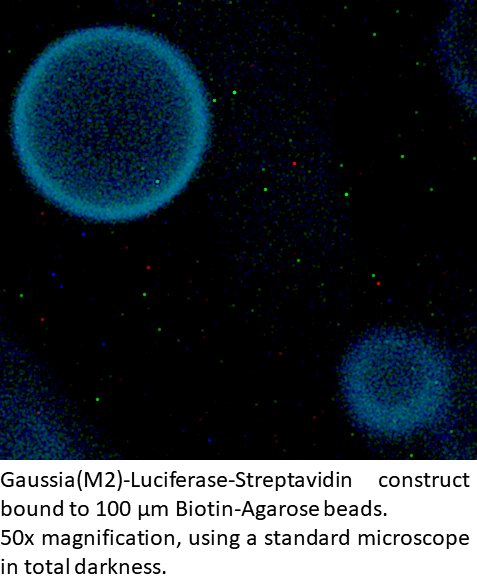
| |||||||||||
| 381 | NanoKAZ Luciferase, an Oplophorus Luciferase mutant is one o ... | 
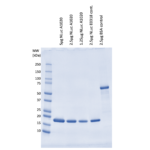
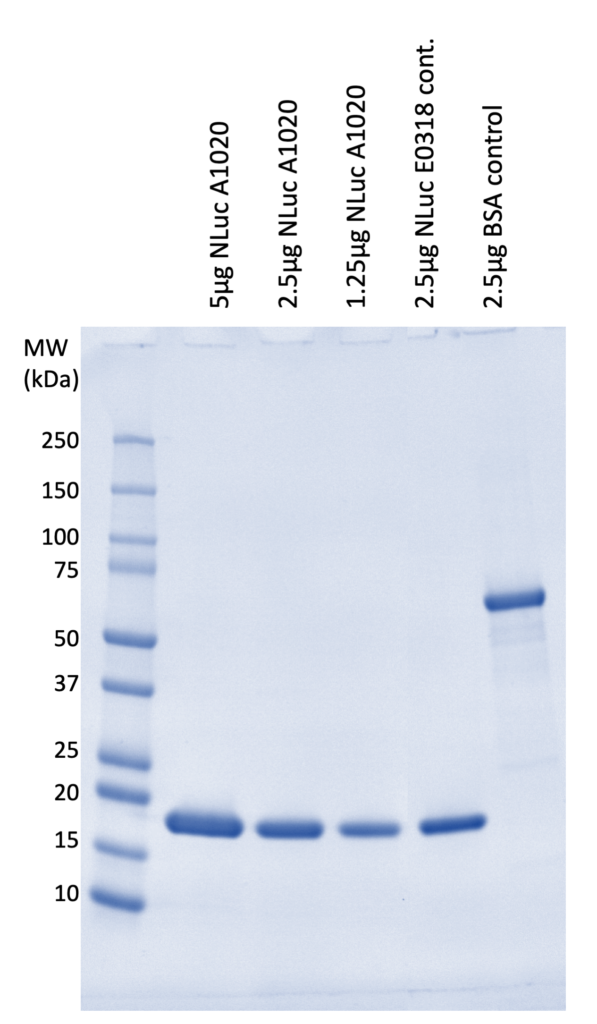
NanoKAZ Luciferase, an Oplophorus Luciferase mutant is one of the smallest and brightest luciferases. This recombinant protein was affinity purified to give it a maximum specific activity. Patent US 9,315,783 and US 9,404,145. NanoKAZ Luciferase (NLuc) Protein Details |
| Compound ID | NanoKAZ Luciferase (NLuc) enzyme |
| MW | 19.2 kDa (theoretical) |
| Appearance | clear liquid as 1 mg/ml in TBS |
| Applications | as positive control in luminometer assays and general assay optimization |
| Production | recombinant expression in E.coli with subsequent affinity purification |
Sequence
MVFTLEDFVGDWRQTAGYNLDQVLEQGGVSSLFQNLGVSVTPIQRIVLSGENGLKIDIHVIIPYEGLSGDQMGQIEKIFKVVYPVDDHHFKVILHYGTLVIDGVTPNMIDYFGRPYEGIAVFDGKKITVTGTLWNGNKIIDERLINPDGSLLFRVTINGVTGWRLCERILA
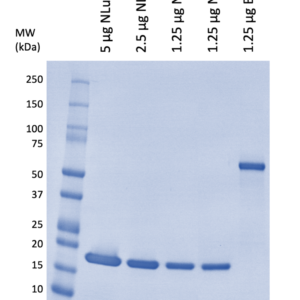
SDS-PAGE
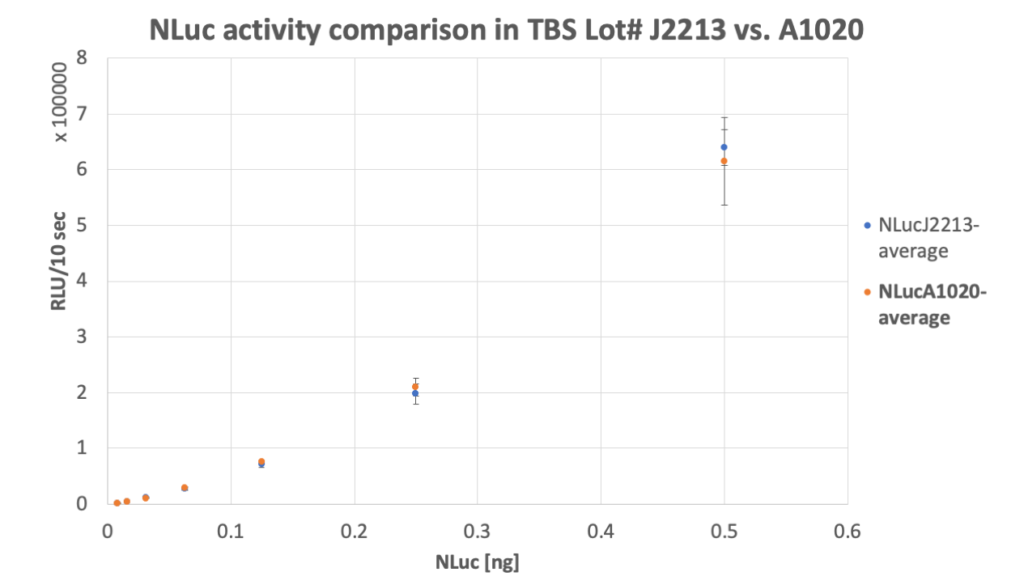
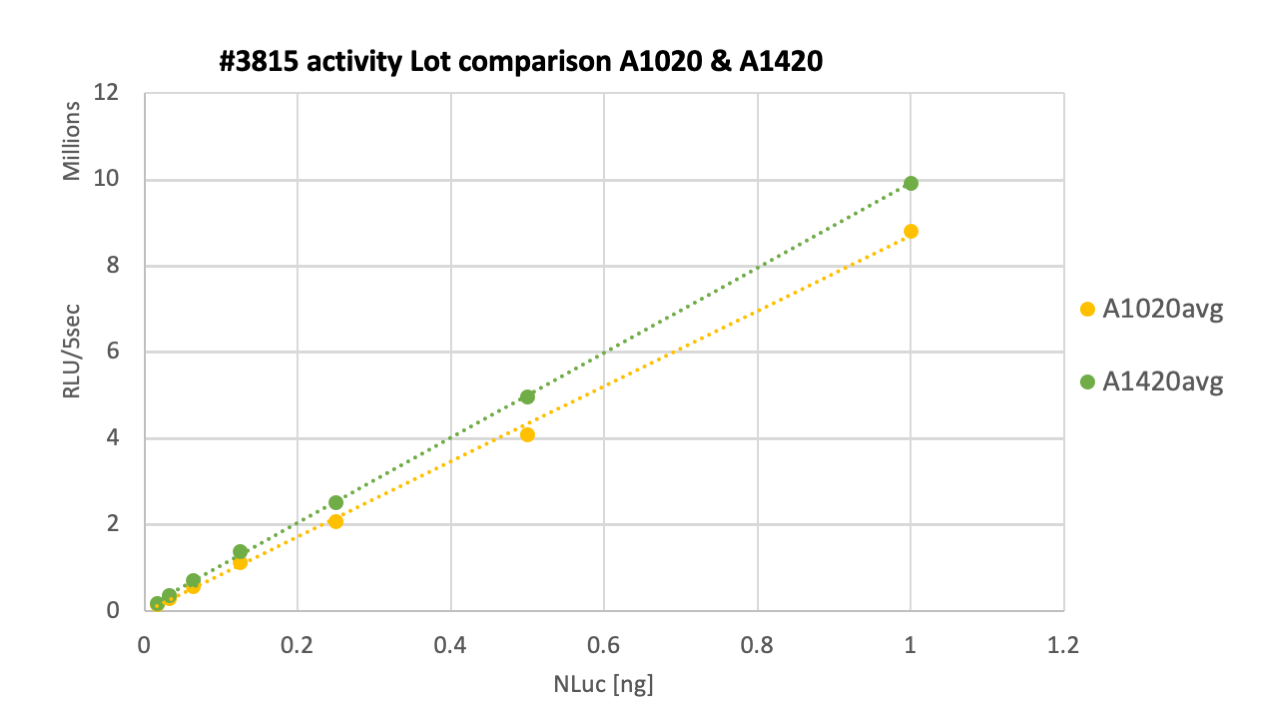
Activity
NanoKAZ Luciferase in PBS, an Oplophorus Luciferase mutant is one of the smallest and brightest luciferases. This recombinant protein was affinity purified to give it a maximum specific activity. Buffered in PBS for convenient linkage chemistry where Tris (or other primary amines) would interfere. Patent US 9,315,783 and US 9,404,145.
NanoKAZ Luciferase Protein (PBS) Details
| Compound ID | NanoKAZ Luciferase (NLuc) enzyme (PBS) |
| MW | 19.2 kDa (theoretical) |
| Appearance | clear liquid as 1mg/ml in TBS |
| Applications | as positive control in luminometer assays and general assay optimization |
| Production | recombinant expression in E.coli with subsequent affinity purification |
Sequence
MVFTLEDFVGDWRQTAGYNLDQVLEQGGVSSLFQNLGVSVTPIQRIVLSGENGLKIDIHVIIPYEGLSGDQMGQIEKIFKVVYPVDDHHFKVILHYGTLVIDGVTPNMIDYFGRPYEGIAVFDGKKITVTGTLWNGNKIIDERLINPDGSLLFRVTINGVTGWRLCERILA
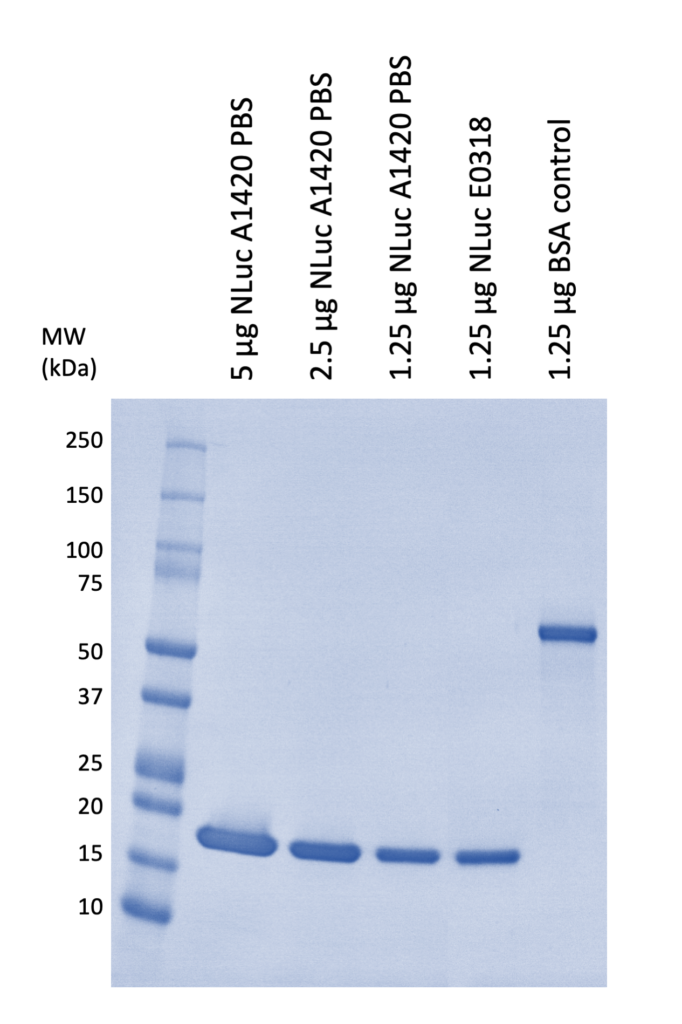
SDS-PAGE
Activity
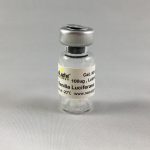
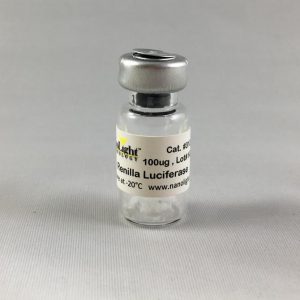
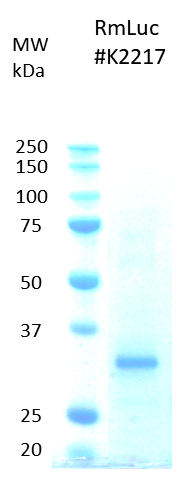
95% purity (recombinant). Supplied as lyophilized powder. ABS280 of 0.63 = 1.0 mg RM Luc
Renilla Mulleri Luciferase Details
MTSKVYDPELRKRMITGPQWWARCKQMNVLDSFINYYDSEKHAENAVIFLHGNAASSYLWRHVVPHVEPVARCIIPDLIGMGKSGKSGNGSYRLLDHYKYLTEWFKHLNLPKKIIFVGHDWGACLAFHYCYEHQDRIKAVVHAESVVDVIESWDEWPDIEEDIALIKSEEGEKMVLENNFFVETMLPSKIMRKLEPEEFAAYLEPFKEKGEVRRPTLSWPREIPLVKGGKPDVVEIVRNYNAYLRASHDLPKMFIESDPGFFSNAIVEGAKKFPNTEFVKVKGLHFSQEDAPDEMGNYIKSFVERVLKNEQ
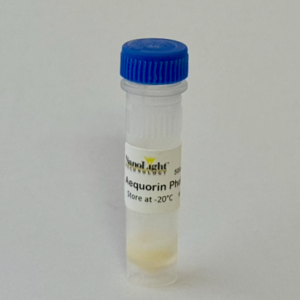
A photoprotein originating from the jellyfish Aequorea victoria emits light in the presence of a trace amount of Ca2+ without the requirement of any other cofactor. Aequorin was “charged” with unmodified (native) Coelenterazine and will emit light at 465 nm upon Ca2+ contact.
Aequorin photoprotein (liquid) Details
Aequorin photoprotein (untagged) is recombinantly produced in E. coli, purified via multi-step chromatography and appears as a yellow liquid.
Concentration
2 mg/ml in 1.2M (NH4)2SO4, 250 μl per tube
Sequence
MTSKQYSVKLTSDFDNPRWIGRHKHMFNFLDVNHNGKISLDEMVYKASDIVINN
LGATPEQAKRHKDAVEAFFGGAGMKYGVETDWPAYIEGWKKLATDELEKYAKNE
PTLIRIWGDALFDIVDKDQNGAITLDEWKAYTKAAGIIQSSEDCEETFRVCDIDESG
QLDVDEMTRQHLGFWYTMDPACEKLYGGAVP
Applications
positive control in Ca2+ assays
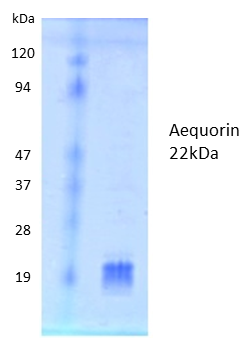
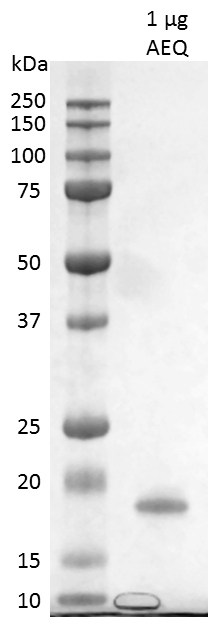
Purity > 95% by SDS-PAGE
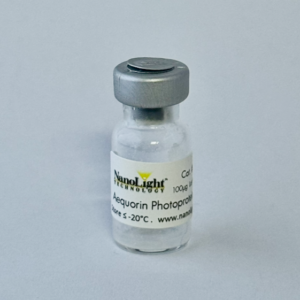
A photoprotein originating from the jellyfish Aequorea victoria emits light in the presence of a trace amount of Ca2+ without the requirement of any other cofactor. Aequorin was “charged” with unmodified (native) Coelenterazine and will emit light at 465 nm upon Ca2+ contact.
Aequorin photoprotein (lyophilized) Details
Aequorin photoprotein (untagged) is recombinantly produced in E. coli, purified via multi-step chromatography and appears as a white lyophilized powder.
Reconstitution
with Ca2+ free double distilled water
Sequence for Aequorin-2 (P02592), 196 amino acids, 22.3 kDa
MTSKQYSVKLTSDFDNPRWIGRHKHMFNFLDVNHNGKISLDEMVYKASDIVINN
LGATPEQAKRHKDAVEAFFGGAGMKYGVETDWPAYIEGWKKLATDELEKYAKNE
PTLIRIWGDALFDIVDKDQNGAITLDEWKAYTKAAGIIQSSEDCEETFRVCDID

ESGQLDVDEMTRQHLGFWYTMDPACEKLYGGAVP
Application
postitive control in Ca2+ assays
Purity > 95% by SDS-PAGE
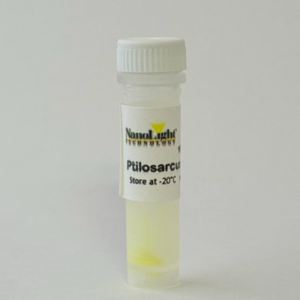
Highly purified single band on SDS gels, very active and bright GFP. Has much higher absortion and 495nm excitation, with 3X the fluorescence of eGFP or Aequoia GFP. Emission at 508nm. For best performance should be used with proper filter set.
Ptilosarcus Green Fluorescent protein Details
Ptilosarcus GFP is a highly purified, His-tagged green fluorescent protein isolated from the sea pen Ptilosarcus, offering researchers a brighter alternative to conventional fluorescent tags. With excitation and emission maxima at 495 nm and 508 nm respectively, this ~27 kDa protein delivers roughly three times the brightness of eGFP or Aequorea GFP, along with substantially higher absorption — making it well suited for applications where signal intensity matters most. Each lot runs as a single band on SDS-PAGE, reflecting the purity standard behind every NanoLight fluorescent protein. Supplied as a stable solid, it should be stored dark at -20°C (or -80°C for long-term storage) and ships at room temperature via overnight or 2-day domestic courier. Available in 1 mg and 10 mg sizes to fit both pilot studies and larger-scale work.
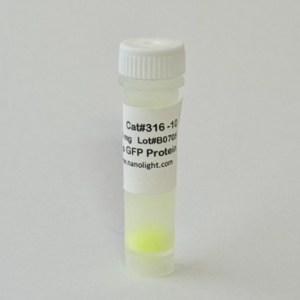
Highly purified single band on SDS gels, very active and bright GFP. Has much higher absortion and 495nm excitation, with 3X the fluorescence of eGFP or Aequoia GFP. Emission at 508nm. For best performance should be used with proper filter set.
Renilla Reniformis GFP Details
Renilla Reniformis GFP is a highly purified green fluorescent protein isolated from the sea pansy Renilla reniformis, giving researchers a brighter, high-purity alternative to standard fluorescent tags. With excitation and emission maxima at 495 nm and 508 nm respectively, it delivers roughly three times the brightness of eGFP or Aequorea GFP, making it a strong choice for applications where signal strength is critical. Each lot is verified as a single band on SDS-PAGE, consistent with the purity standard behind every NanoLight fluorescent protein. Supplied purified and ready for use, it should be stored dark at -20°C (or -80°C for extended shelf life) and ships at room temperature via overnight or 2-day domestic courier. Available in 1 mg and 10 mg sizes, with a Certificate of Analysis available for download.