Benzyl Coelenterazine (h-CTZ) in sterile injection vials with a low retention volume. Each kit is supplied with two ‘Inject-A-Lume’ vials of 500 µg h-CTZ and a sterile ‘Fuel-Inject’ diluent.
For animal use only.
Package Contents:
500 ugs – 1 vial of 500 ugs lyophilized SOL-CTZ-h
1 mgs – 2 vials of 500 ugs lyophilized SOL-CTZ-h
10 mgs – 20 vials of 500 ugs lyophilized SOL-CTZ-h
Coelenterazine compounds are often dissolved in Propyleneglycol (PG) in combination with other alcohols for in vivo imaging studies. Large intravenous doses of PG given over a short period of time can be toxic, including hyperosmolality, increased anion gap metabolic acidosis (due to lactic acidosis), acute kidney injury, and sepsis-like syndrome.
This can be avoided using water-soluble h-Coelenterazine. It is formulated to be isosmotic and easily secreted by the kidneys. Thus save for repeated i.v. injections. Water-soluble h-Coelenterazine can be injected up to a 500 µg/100 µl concentration, achieving very high Coelenterazine levels within the body and leading to high luciferase signals.
h-Coelenterazine is one of the preferred substrates for Renilla Luciferase.
If you use Gaussia Luciferase in your assay please use Cat. #3031
Advantages of water-soluble Coelenterazine
- non-toxic, iso-osmotic, Propylene-Glycol free, Alcohol free
- long shelf-life, sealed under vacuum
- dissolves fast in sterile water
- low viscosity – ideal for injections
- consistent quality due to small aliquot sizes
Controls
We offer the solubilization vehicle without the h-Coelenterazine as injection control. Any side effects due to the injection process can be easily monitored, especially in sensitive applications like bioluminescent driven Optogenetics. One vial of the control (
Cat. #3011-10+C) contains the same amount of solubilizer as one vial of Cat.#3011. The control will be dissolved in sterile water to create an iso-osmotic solution ready to inject.
To order control: please select ’10 mgs + 10 vials control’ under available sizes. This includes 20 vials of 500 µg water-soluble h-CTZ and 10 vials of control.
Please inquire if larger quantities of Cat.#3011-10+C are needed.
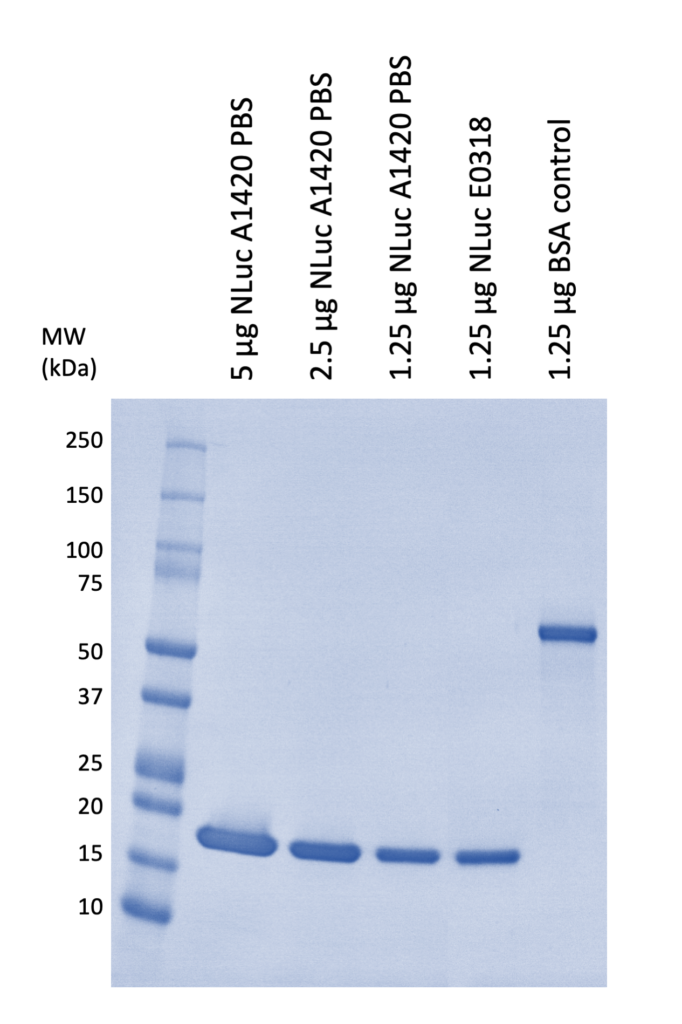
Renilla Reniformis GFP is a highly purified green fluorescent protein isolated from the sea pansy Renilla reniformis, giving researchers a brighter, high-purity alternative to standard fluorescent tags. With excitation and emission maxima at 495 nm and 508 nm respectively, it delivers roughly three times the brightness of eGFP or Aequorea GFP, making it a strong choice for applications where signal strength is critical. Each lot is verified as a single band on SDS-PAGE, consistent with the purity standard behind every NanoLight fluorescent protein. Supplied purified and ready for use, it should be stored dark at -20°C (or -80°C for extended shelf life) and ships at room temperature via overnight or 2-day domestic courier. Available in 1 mg and 10 mg sizes, with a Certificate of Analysis available for download.
Package Contents:
500 ugs – 1 vial of 500 ugs lyophilized CTZ 400a
1 mgs – 2 vials of 500 ugs lyophilized CTZ 400a
5 mgs – 1 vial of 5 mgs lyophilized CTZ 400a
10 mgs – 2 vials of 5 mgs lyophilized CTZ 400a
Advantages
- pre-aliquoted in small amounts, fresh substrate for every set of experiments
- long shelf-life (packed under Argon)
- faster to dissolve due to its fine crystal structure
- consistent quality between aliquotes
The luciferin is shipped as filtered, lyophilized, batch controlled substrate
e-coelenterazine or Coelenterazine-E (e-CTZ) is a synthetic analogue of native Coelenterazine with an additional ethyl group, forming an additional ring system. First described by Shimomura in 1989.
For Renilla muelleri Luciferase, an increase of 750% in initial intensity and 137% in total light was observed using e-Coelenterazine compared to naitve Coelenterazine.
Note: In will not be utilized by Gaussia Luciferase.